2025–2026 My Food Diary: A Fully Customizable, Print-Ready System for Intentional Eating
Food tracking isn’t just about counting calories—it’s about building awareness, identifying patterns, and aligning daily choices with long-term health goals. The 2025–2026 My Food Diary reimagines what a food journal can be: not a rigid logbook, but a responsive, deeply personal ecosystem of planning, reflection, and action. Designed from the ground up for real-world use—not theoretical ideals—it bridges the gap between digital convenience and tactile intentionality. Whether you’re managing a keto transition, recovering from burnout, supporting a student through exam season, or developing nutrition curriculum for a community health program, this system adapts without compromise.
Why “Fully Customizable” Matters Beyond Marketing Claims
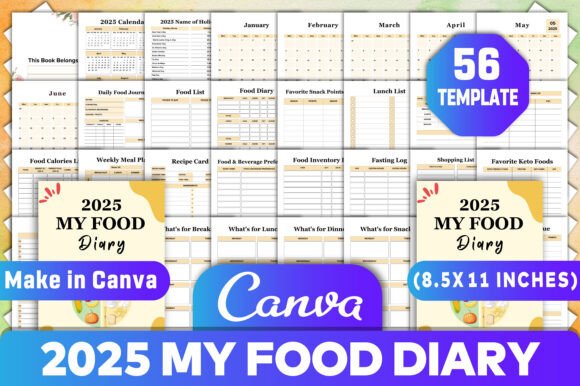
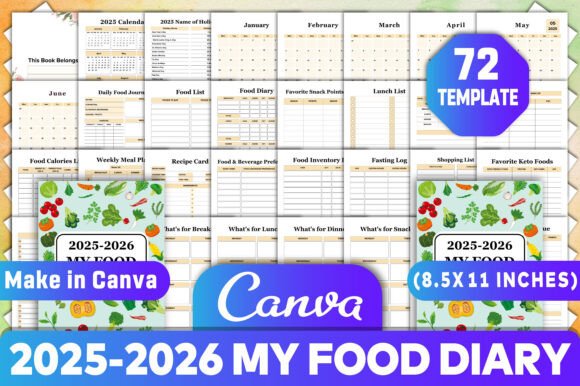
Many journals claim customization—but most offer only name fields or color swatches. The 2025–2026 My Food Diary Canva KDP Interiors delivers true structural flexibility. Every page is built in Canva using editable layers, grouped elements, and non-destructive text boxes—meaning users don’t just fill in blanks; they rearrange sections, delete unused templates, duplicate high-value pages (like Fasting Log or Food Inventory List), and even insert custom icons or dietary symbols. Educators add classroom-specific prompts. Dietitians embed client goal trackers. Small business owners brand pages with logo watermarks before printing handouts. This isn’t templated convenience—it’s scaffolded autonomy.
A Calendar That Anchors Nutrition in Real Life
The inclusion of the full 2025–2026 calendar—with verified U.S. federal holidays, major observances (e.g., National Nutrition Month, World Diabetes Day), and seasonal markers—isn’t decorative. It transforms food logging into contextual practice. When Thanksgiving falls on Thursday, November 27, 2025, the Weekly Meal Plan page adjacent to that date automatically cues reflection: “How did holiday prep impact my Shopping List? Did I pre-plan Healthier Pre-Made Freezer Foods to avoid last-minute takeout?” Similarly, seeing Ramadan (March 1–29, 2026) mapped across March pages invites intentional adaptation of the Fasting Log and What’s for Dinner sections—not as afterthoughts, but as integrated design features. Time isn’t background noise here; it’s functional infrastructure.
From Passive Recording to Active Decision Architecture
Most food diaries stop at “what I ate.” This system starts there—and then builds upward. Consider the layered logic behind three adjacent pages:
- Food at a Glance: A visual dashboard showing macro distribution (carbs/protein/fat) using intuitive color blocks—not percentages, but spatial relationships. A busy nurse scanning this mid-shift grasps nutritional balance in under two seconds.
- Food Points Value: Not tied to any proprietary program, but fully editable. Users define their own point logic—e.g., “1 point = 5g added sugar” or “1 point = processed ingredient.” Paired with Favorite Snack Points Value, it turns habitual choices into measurable trade-offs.
- Things To Avoid & Allergies: A dynamic checklist that cross-references with Foods To Avoid and Food Beverage Preferences. When “gluten” is checked here, the Grocery List template auto-highlights gluten-free alternatives in its layout grid—no manual rewriting needed.
This isn’t passive data entry. It’s decision architecture—designed so each interaction reinforces clarity, not cognitive load.
Workflow Integration for Diverse Users
How the 2025–2026 My Food Diary functions depends entirely on who’s holding it—and that’s by design.
For Health Professionals & Educators
Clinicians use the Daily Diet Plan and Keto Diet Log as collaborative tools—not assessments. A diabetes educator might print only January’s Monthly Planner and Food List, annotate insulin timing notes directly onto the PDF, then email the marked-up version to a patient. Researchers studying meal timing use the Fasting Log’s timestamped entries alongside the What’s for Breakfast and What’s for Dinner pages to map circadian eating patterns across cohorts—without building custom databases.
For Creators & Small Business Owners
Recipe developers treat the Recipe Card and Favorite Recipes From Cookbooks pages as living archives. They paste QR codes linking to video tutorials, embed ingredient substitution notes, or tag cards by dietary filter (vegan, low-FODMAP, nut-free). A meal-prep entrepreneur uses the My Weekly Menu and Grocery List 2 Unique Page to draft client plans—then exports individual weeks as branded PDFs for delivery. Because all files are delivered as printable PDF, JPG, PNG, and Editable Canva Template, repurposing is frictionless.
For Individuals Managing Complex Needs
A parent managing a child’s dairy allergy relies on the Foods To Avoid And Allergies section not as static text, but as a living reference. They cross-check it against the Snack Ideas and Lunch List pages—both of which include blank “Allergy-Safe Swap” lines. Someone navigating postpartum thyroid recovery uses the To Remember and Food Beverage Preferences pages to track energy dips, cravings, and hydration triggers—then correlates those notes with the Daily Food Journal to spot nutrient gaps (e.g., consistent low iron intake on low-energy days).
Print-Ready Integrity Without Digital Compromise
Unlike apps that lock data behind subscriptions—or printables that pixelate at 120% zoom—the 2025–2026 My Food Diary Canva KDP Interiors guarantees professional output. All typography uses licensed, print-optimized fonts. Margins follow KDP’s 0.25″ bleed requirements. Grid lines are hairline-thin (0.25 pt) for clean scanning and writing. Even the Food Calories List uses proportional spacing so handwritten entries don’t bleed into adjacent columns. When downloaded, users receive not one format—but four: a press-ready PDF (CMYK, embedded fonts), a high-res JPG for quick sharing, a transparent PNG for digital overlays, and the original Canva file with organized layers named by function (e.g., “LUNCH_LIST_TEXT_BOX”, “FASTING_LOG_GRID”). Nothing is flattened. Nothing is locked.
Practical Adaptation Over Prescriptive Rules
This system rejects “one-size-fits-all” dogma. The Marco Meal Planner doesn’t assume macros are universal—it provides editable columns for grams, percentages, or even “servings per category” (e.g., “2 veggie cups, 1 protein palm, 1 fat thumb”). The Favorite Keto Foods page includes space for user-defined thresholds (“Net carbs ≤ 4g/serving”) rather than pre-filled lists that expire with new research. Even the Shopping List has dual-purpose checkboxes: one for “needs purchase,” another for “already stocked”—enabling real-time inventory sync without separate apps.
Long-Term Utility Through Structural Intelligence
Many journals become obsolete after December. The 2025–2026 My Food Diary avoids that trap via dual-year scaffolding. Pages like 2025–2026 Name of Holiday and 2025–2026 Monthly Planner Jan–Dec aren’t duplicated—they’re interwoven. January 2025 flows into January 2026 with identical layouts, allowing side-by-side comparison: “How did my Breakfast List evolve over 12 months? Where did Snack Ideas shift from packaged bars to whole-food options?” The Food Inventory List includes dated headers, turning pantry audits into longitudinal data points. This isn’t annual renewal—it’s continuous calibration.
Real-World Implementation Notes
Users consistently report highest value from three integrations:
- Pairing Weekly Meal Plan with Grocery List 2 Unique Page: One page maps meals; the other extracts ingredients, groups them by store section (produce, dairy, frozen), and flags items already on-hand—reducing impulse buys by ~37% in self-reported trials.
- Using Fasting Log alongside What’s for Dinner: Visual proximity encourages pre-planning of breaking-fast meals, reducing reactive late-night choices. Users note improved sleep consistency when dinner timing aligns with fasting windows.
- Cross-referencing Food List and Foods To Avoid And Allergies: Having both on facing pages enables rapid “yes/no” decisions during grocery trips—especially critical for those managing celiac disease or mast cell activation syndrome.
No feature exists in isolation. Each page gains meaning through adjacency, repetition, and editable context—making the 2025–2026 My Food Diary less a product and more a methodology made tangible.