Easy Sudoku Vol.1–100 PNG with Answers: A Practical Resource for Creators and Educators
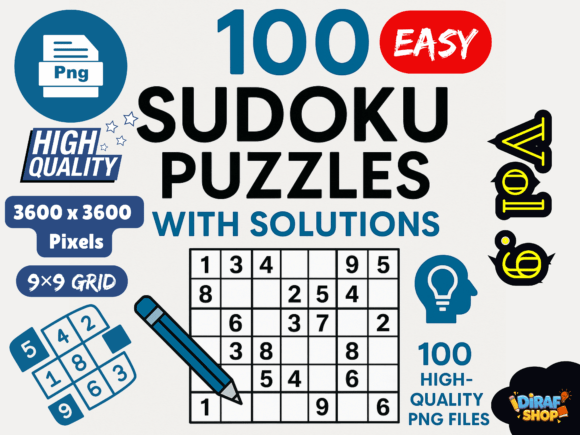
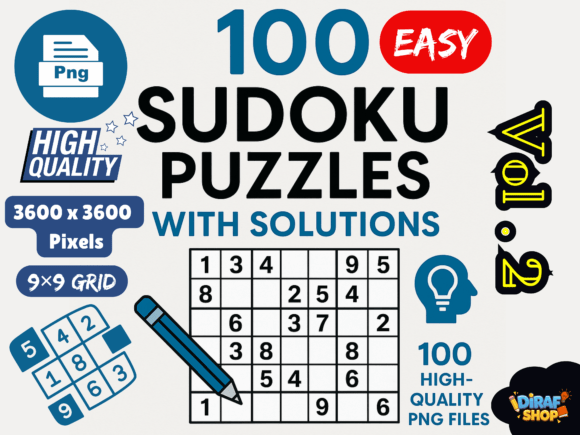
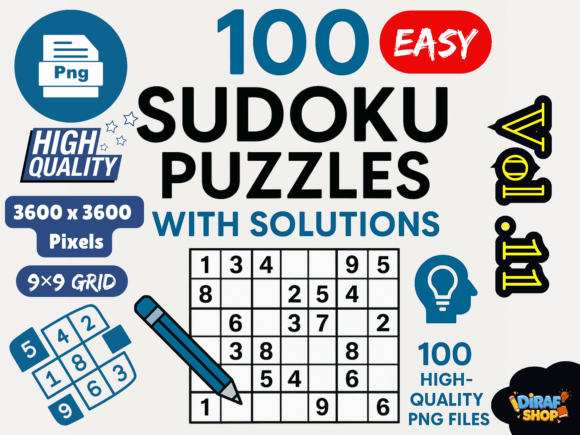
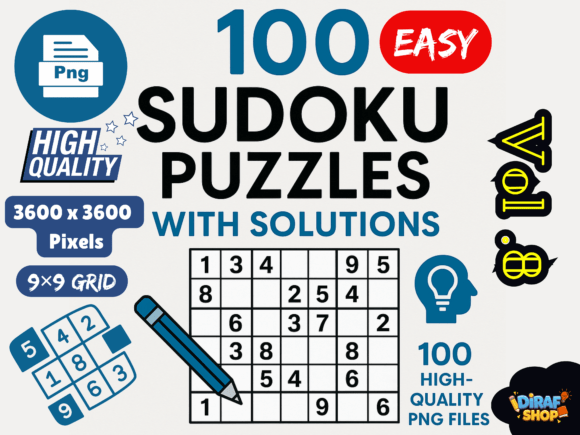
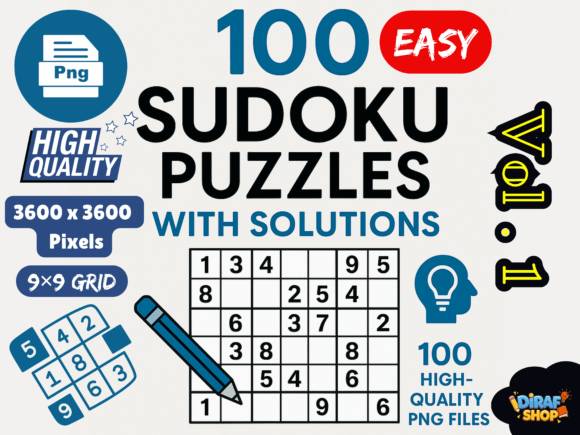
Easy Sudoku Vol.1–100 PNG with Answers is a curated digital bundle of 100 beginner-friendly Sudoku puzzles—each delivered as a high-resolution, transparent PNG file at 3600 × 3600 pixels, alongside 100 corresponding solution files. Unlike generative tools or low-fidelity PDFs, this collection prioritizes production readiness: clean 9×9 grids with bold, evenly spaced lines, consistent typography, and visual clarity optimized for both print and screen. It’s designed not as a standalone app or interactive experience, but as a foundational asset—ready to embed, scale, or compile without editing, formatting, or troubleshooting.
How It Fits Into the Broader Puzzle Resource Landscape
Most Sudoku resources fall into one of three categories: dynamic generators (like online puzzle builders or Python-based scripts), preformatted books (often locked in fixed layouts or proprietary formats), or editable vector files (such as SVG or layered PSDs). Easy Sudoku Vol.1–100 PNG with Answers occupies a specific middle ground—it trades flexibility for immediacy. You won’t be able to adjust font weights, swap colors, or reposition grid elements mid-design. But you also won’t need to export, crop, or manually align hundreds of puzzles before compiling a KDP interior or Etsy printable.
Compared to free online generators, this bundle offers consistency across all 100 puzzles: uniform spacing, identical cell sizing, and standardized numbering placement. That matters when assembling a 120-page adult activity book—readers notice misaligned grids or inconsistent boldness between pages. Compared to editable vector files, PNGs eliminate compatibility issues across design platforms (e.g., Canva, Affinity Publisher, Adobe InDesign) and avoid rendering quirks that sometimes appear with complex SVG paths or embedded fonts.
Key Strengths for Real-World Use Cases
The primary advantage of Easy Sudoku Vol.1–100 PNG with Answers lies in its purpose-built structure for commercial publishing workflows. Each puzzle and solution is delivered as a standalone, transparent-background PNG—meaning it integrates cleanly into multi-element layouts. For example, if you’re designing a “Sudoku & Coffee” themed workbook, you can place a puzzle directly over a textured background or beside hand-drawn icons without white-box artifacts. The 3600 × 3600 resolution supports crisp printing at common book sizes (5.5″ × 8.5″, 6″ × 9″, or A4) without pixelation—even when scaled down slightly for margins or sidebars.
The folder organization—separate Puzzles and Solutions directories—supports efficient batch processing. Designers using automation tools (like InDesign data merge or Python-based PDF assembly scripts) can reference both sets programmatically. And because all files are ready for commercial use, there’s no need to verify licensing terms per puzzle or clear usage rights with third-party libraries.
Tradeoffs to Consider Before Choosing
While the convenience is significant, the format does impose practical limits. PNGs are raster images—not scalable vectors—so extreme enlargement (e.g., poster-sized prints above 24″ wide) may reveal subtle aliasing along grid lines. If your project requires responsive resizing across multiple output formats (web, tablet, large-print), a vector-based alternative may offer more long-term adaptability.
Additionally, the “easy” difficulty level is intentionally accessible—ideal for newcomers, seniors, or classroom warm-ups—but not suited for audiences seeking progressive challenge curves. There’s no built-in difficulty progression (e.g., easy → medium → hard within the set), nor variant rules (e.g., diagonal Sudoku or irregular regions). If your goal is to build a tiered logic series or support differentiated instruction, you’d need to supplement this bundle with additional resources.
Another consideration is customization depth. Because each puzzle is a flat image, you cannot dynamically insert branding elements (e.g., watermarks, logos, or instructional callouts) *within* the grid itself—only around it. If your product strategy relies on embedded prompts (“Tip: Look for hidden singles in Row 4”), those would need to be added separately in your layout software.
When This Bundle Is the Right Choice
Easy Sudoku Vol.1–100 PNG with Answers works best when speed, consistency, and compatibility outweigh granular control. It’s particularly well-suited for creators who:
- Are building Amazon KDP interiors and need print-ready assets that comply with Kindle Direct Publishing’s image guidelines;
- Produce seasonal or themed printable bundles for Etsy or Gumroad and want to minimize post-production time;
- Develop adult activity books focused on relaxation, light mental engagement, or gentle cognitive maintenance;
- Work with non-designers (e.g., educators or content writers) who need plug-and-play files without requiring graphic design training;
- Prefer predictable output over iterative experimentation—knowing exactly how Puzzle #47 will look on page 63 of their final PDF.
A real-world example: A freelance designer creating a “Mindful Mornings” workbook for a wellness brand used Easy Sudoku Vol.1–100 PNG with Answers to populate 30 pages of daily puzzles. Because each PNG imported cleanly into Canva, they completed layout in under six hours—compared to an estimated 20+ hours using a generator that required manual export, cropping, and alignment per puzzle.
When You Might Explore Alternatives
If your project calls for deeper interactivity—such as timed solving, auto-checking, or mobile-responsive navigation—this bundle isn’t designed for that use case. Similarly, if you need puzzles in non-standard grid formats (e.g., 4×4 for children or 16×16 for advanced solvers), or require multilingual number sets (e.g., Arabic numerals or kanji variants), you’ll need a more customizable or specialized source.
For educators building lesson plans with scaffolding, a spreadsheet-based generator with adjustable constraints may offer more pedagogical flexibility—allowing them to isolate specific techniques (naked pairs, pointing pairs) or generate puzzles targeting particular logical steps. Likewise, publishers developing subscription-based digital products may prefer API-accessible puzzle services that deliver fresh, algorithmically verified content monthly—rather than a static, one-time bundle.
Making an Informed Decision
Choosing Easy Sudoku Vol.1–100 PNG with Answers isn’t about finding the “best” Sudoku resource overall—it’s about matching format to function. Ask yourself: Do I need 100 reliable, visually consistent, production-ready puzzles—today—with minimal setup? If yes, this bundle eliminates friction. If instead you prioritize adaptability, scalability, or instructional granularity, then evaluating editable templates, open-source generators, or licensed puzzle APIs may better serve your longer-term goals.
There’s no universal “right” answer—only what fits your timeline, technical comfort, distribution channel, and audience expectations. Easy Sudoku Vol.1–100 PNG with Answers excels where reliability and efficiency matter most: turning concept into shipped product, without detours through design limbo.